

Why do dating apps feel fake even when millions of people use them every day?
Online dating has become part of everyday life. According to Pew Research Center, nearly 30 percent of adults in the United States have used a dating app. On the surface, that level of adoption suggests success. However, many users report the opposite experience.
Instead of meaningful conversations, people often encounter ghosting, low effort replies, or matches that disappear without explanation. In other cases, profiles look overly polished, yet interactions feel distant or scripted. Because of this, trust gradually declines.
More importantly, this perception is not random. It reflects deeper structural issues within how dating platforms operate. From automated accounts to engagement focused algorithms, multiple factors shape user experience in ways that do not always support real connections. This is also why many users now question whether dating app algorithms are failing real connections instead of helping people build genuine compatibility.
To understand why dating apps feel fake, it is necessary to look beyond individual interactions and examine the system behind them.
Dating apps feel fake mainly because of bots, inactive profiles, and engagement driven algorithms. In 2026, many platforms prioritize swiping over real connections, which often leads to low quality matches and declining trust. Additionally, inconsistent user behavior such as ghosting reinforces this perception. However, fake experiences can be reduced. By recognizing red flags, improving profile quality, and choosing platforms that prioritize compatibility and real interactions, users can significantly increase their chances of forming genuine connections. This pattern also explains why many people feel that dating apps are a waste of time when activity does not lead to real interaction.
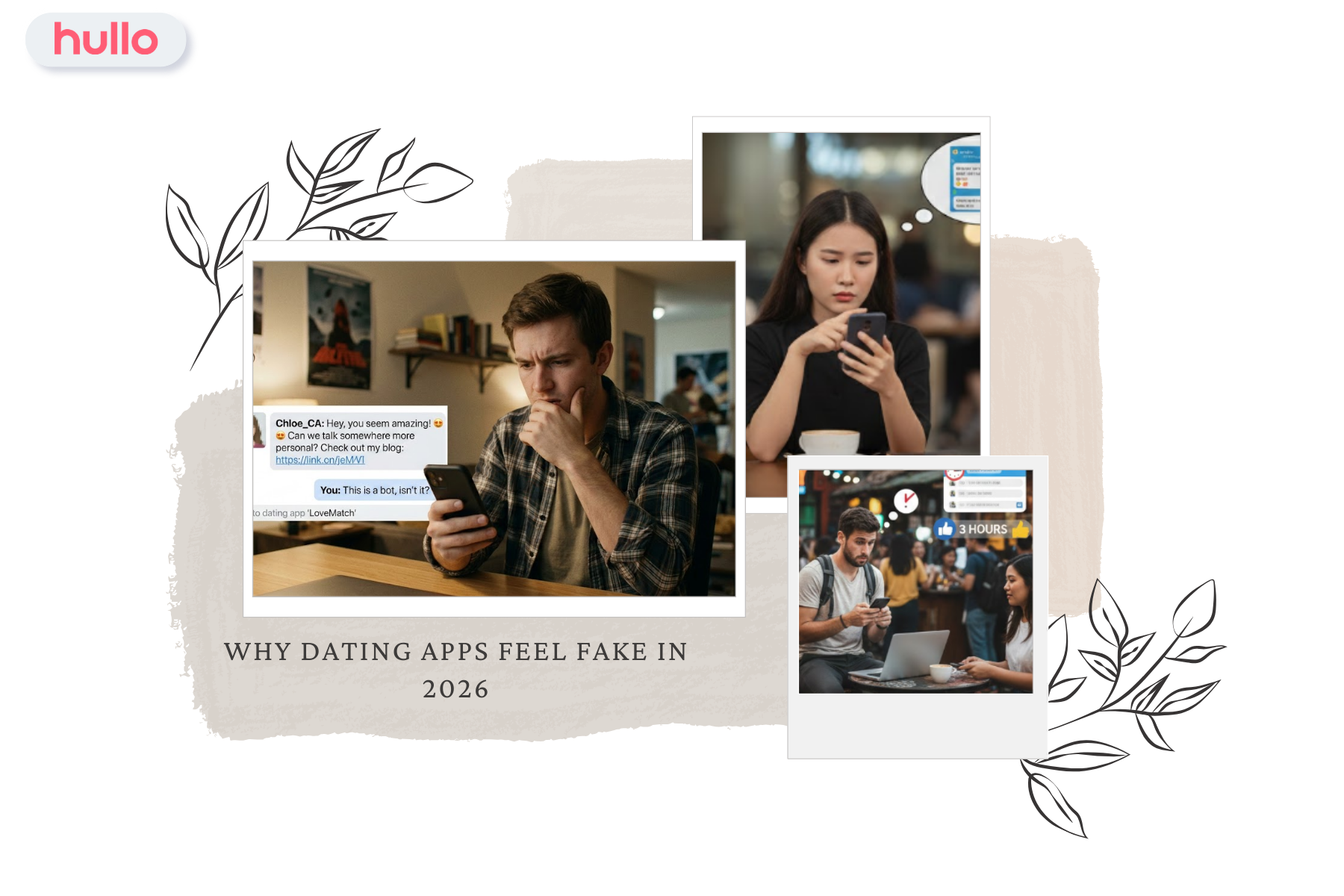
Why Do So Many Dating Apps Feel Fake?
At first glance, it may seem like a personal issue. However, the reason dating apps feel fake is largely systemic rather than individual.
To begin with, many platforms struggle to maintain a fully active and verified user base. While thousands of profiles appear available, a significant portion may be inactive. As a result, users send messages but receive no response, which creates the impression of interacting with something artificial.
In addition, bot accounts and scam profiles continue to exist across most large platforms. Even when users recognize these accounts quickly, repeated exposure still affects trust. Over time, people begin to question whether any interaction is real. Meanwhile, the endless browsing experience can create mental exhaustion, a pattern explored in swiping culture and decision fatigue in modern dating.
Another important factor is algorithm design. Many dating apps are built to maximize engagement, not necessarily compatibility. Therefore, users are encouraged to swipe more frequently, yet meaningful conversations do not always follow. This disconnect between activity and outcome contributes to the feeling that something is off.
Furthermore, moderation systems vary widely. Some platforms actively filter suspicious behavior, while others rely heavily on user reports. When enforcement is inconsistent, problematic accounts remain visible longer than expected.
Ultimately, the issue is not just fake profiles. It is how the entire system shapes interaction quality.
Hullo is an AI powered matchmaking app that analyzes behavioral patterns, zodiac compatibility, interests, and location signals to suggest meaningful matches. Instead of relying purely on swiping, Hullo integrates machine learning to improve match relevance and reduce fake interactions. Features like First Voice allow users to hear someone’s real voice before chatting, helping create more authentic and human connections.
The 5 Most Common Reasons Dating Apps Feel Fake
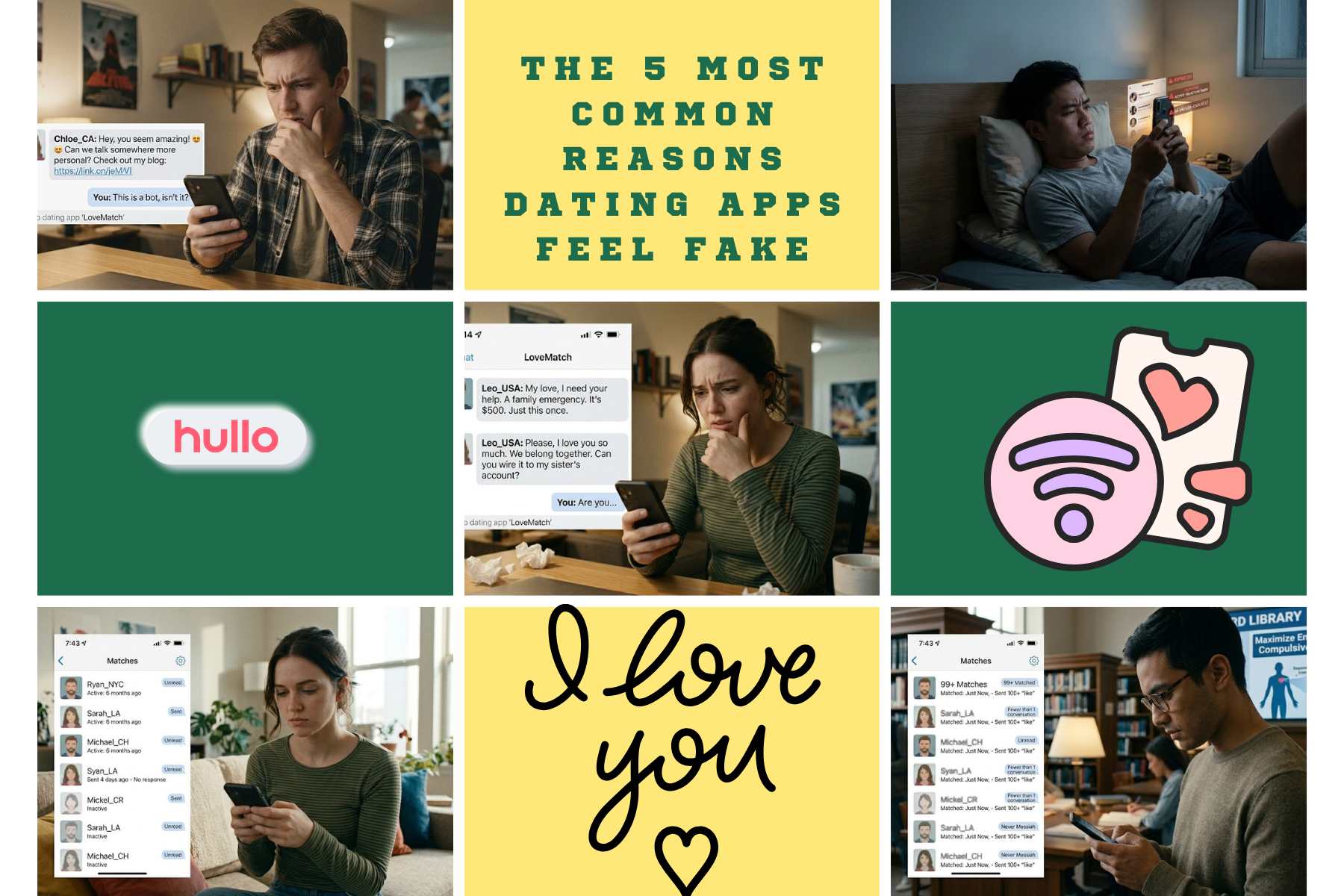
Bot accounts and automation
One of the clearest reasons dating apps feel fake is the presence of automated accounts. These bots are designed to mimic human behavior, yet they often fail to replicate natural conversation patterns.
According to the Imperva Bad Bot Report, automated traffic represents a significant share of overall internet activity. While not all bots are harmful, their presence in dating apps creates confusion.
For example, bots tend to respond instantly and use repetitive language. They may also avoid answering specific questions. Because of this, conversations feel predictable rather than genuine.
Romance scams and catfishing
Beyond automation, romance scams play a major role in shaping user perception. The Federal Trade Commission reports that financial losses from romance scams reach billions of dollars annually.
Typically, scammers create emotional connections very quickly. However, they often avoid video calls and introduce complicated personal stories. Eventually, they request financial help.
Even when users are aware of these tactics, the overall environment becomes more cautious. As a result, genuine interactions may still feel suspicious.
Inactive profiles
Another factor that makes dating apps feel fake is inactivity. Many platforms continue to show profiles that are no longer active.
Consequently, users invest time writing messages that are never read. Over time, this creates frustration and reduces motivation to engage. Over time, this repeated disappointment can lead to dating app fatigue, especially when users feel their effort is not returned.
This imbalance between visible profiles and active users is known as a liquidity problem. Simply put, the system appears more active than it actually is.
Swipe driven algorithms
In addition to user behavior, platform design also plays a critical role. Many dating apps rely on swipe based systems to increase engagement.
Research summarized by Stanford University shows that variable reward mechanisms encourage repeated interaction. While this keeps users active, it does not guarantee meaningful outcomes.
Instead, users may accumulate matches without building real conversations. Therefore, the experience begins to feel transactional rather than relational. This is one reason dating app matches rarely turn into conversations, even when two people initially show interest.
Weak moderation systems
Finally, moderation determines how safe and trustworthy a platform feels. When moderation is limited, suspicious accounts remain visible longer.
As a result, users repeatedly encounter questionable behavior. Over time, this erodes confidence.
Even real profiles may begin to feel unreliable, not because they are fake, but because the environment lacks consistency.
What Actually Drives Replies
While many users focus on external factors, interaction quality often depends on behavior as well.
According to Hullo data, users who start conversations with personalized questions receive significantly more replies compared to generic openers such as “Hi” or “Hello”.
This finding reflects a broader shift in user expectations. People are increasingly selective about how they engage.
In addition, several patterns stand out:
- Profiles with clear and authentic descriptions tend to receive more responses
- Matches based on shared interests lead to longer conversations
- Voice based interaction increases trust and emotional connection
These observations align with research from Stanford University, which highlights the importance of intentional communication in forming relationships online.
In other words, authenticity directly influences outcomes.
How to Spot Fake Profiles on Dating Apps
If you are wondering why dating apps feel fake in 2026, learning to identify suspicious profiles is essential.
Although no single sign proves deception, patterns often emerge over time.
Some of the most common red flags include:
- Photos that appear overly professional or unrealistic
- Refusal to participate in voice or video calls
- Rapid emotional attachment early in the conversation
- Requests to move to external messaging platforms
- Financial requests or inconsistent personal details
At first, these behaviors may seem minor. However, when combined, they often indicate risk.
At the same time, it is important to avoid overgeneralizing. Not every delayed response or short reply signals a fake account. Context always matters.
Improving your own profile can also reduce confusion. A clear and authentic profile makes it easier for others to trust you.
If you want to strengthen your presence and increase response rates, this guide on dating profile optimization provides practical strategies.
Ultimately, awareness helps you navigate the experience with more confidence.
Hullo offers an AI powered profile assistant that helps users write genuine introductions and avoid generic descriptions. You can try it directly at hullo.dating/ai-bio-generator
Why Matches Don’t Respond and It Feels Fake
Another reason dating apps feel fake is not always related to bots or scams. In many cases, the issue comes from simple non-response behavior.
First, ghosting plays a major role. Users match, exchange a few messages, and then suddenly disappear. While this does not necessarily mean a profile is fake, it creates a similar emotional effect. Over time, repeated ghosting makes the entire dating experience feel unreliable and unpredictable.
This pattern becomes even more frustrating when it happens repeatedly. As a result, many users begin to lose trust in the process itself. Instead of looking forward to new matches, they start expecting conversations to fade without explanation.
Second, there is often a mismatch in expectations. For example, one person may be searching for a serious relationship, while the other is simply browsing casually. Because their goals are different, conversations often stop before they have a chance to develop into something meaningful.
In addition, profile visibility can influence engagement. Even when two people match, there is no guarantee that both users will remain equally active or invested. Some users continue swiping, while others become distracted by new matches. Consequently, conversations may lose momentum before a real connection has time to form.
This dynamic creates a common frustration in online dating. People receive matches, but those matches rarely turn into meaningful conversations. Over time, the gap between matching and connecting makes the experience feel less authentic.
Ultimately, not every silent match is fake. However, repeated non-response behavior, inconsistent communication, and disappearing conversations can create the same feeling of uncertainty. That perception is one of the main reasons many users believe dating apps feel less genuine than they expected.
Are All Dating Apps Fake or Just Poorly Designed
It is easy to assume that all platforms are unreliable. However, not all dating apps feel fake in the same way.
In reality, the difference lies in how each platform is built and managed.
First, moderation systems vary significantly. Some apps actively detect suspicious behavior using behavioral analysis. Others rely mostly on user reporting, which is slower and less consistent.
Second, matching systems influence interaction quality. Platforms that prioritize compatibility tend to produce more meaningful conversations. In contrast, swipe heavy systems often generate more matches but fewer real connections.
Third, active user filtering matters. Apps that prioritize recently active users reduce the chance of unanswered messages. As a result, the experience feels more responsive and real.
Therefore, the issue is not that all apps are fake. Instead, some are simply better designed for real interaction.
How Hullo Creates More Real Connections
As user expectations evolve, platforms must adapt. This is where Hullo takes a different approach.
Instead of focusing only on swiping, Hullo uses AI powered matchmaking to analyze deeper signals. These include behavioral patterns, shared interests, zodiac compatibility, and location context. Because of this layered approach, matches are more relevant from the start.
In addition, Hullo prioritizes real user activity. Inactive profiles are less likely to appear, which reduces the chance of unanswered messages.
Another key feature is First Voice. Rather than relying only on text, users can hear each other’s voice before starting a full conversation. This adds emotional context and helps verify authenticity early.
If you want to explore a dating experience built around real interaction instead of endless swiping, you can learn more in this guide: Introduction to Hullo
Moreover, Hullo uses behavioral filtering to detect unusual activity patterns. This helps reduce exposure to bots without disrupting real users.
Overall, the goal is simple. Make online dating feel human again.
Why Real Connections Still Exist Online
Despite common frustrations, online dating continues to work. In fact, it has become one of the most common ways couples meet.
According to research from Stanford University, meeting online is now a leading method for forming relationships in the United States. This suggests that the concept itself is not the problem.
Instead, the issue often lies in how platforms are designed and how users interact within them.
When dating apps prioritize engagement over compatibility, the experience can feel shallow and repetitive. By contrast, platforms that focus on match quality, communication, and shared interests tend to create more meaningful interactions.
User expectations are also changing. People are becoming less interested in endless swiping and more interested in authentic conversations, compatibility, and genuine connection. As a result, many users are actively looking for dating experiences that feel more intentional and less transactional.
Therefore, real connections are still possible online. The challenge is not whether online dating works. Rather, it is finding platforms and habits that encourage authentic interaction instead of endless activity.
At Hullo, we noticed that users who focus on conversation quality rather than match quantity report higher satisfaction and stronger connections over time. Small shifts in behavior often lead to better dating outcomes than simply increasing the number of matches.
Dating apps feel fake for understandable reasons. Bots, inactive profiles, ghosting, and engagement driven algorithms all contribute to the problem. However, these issues are not unavoidable. These same issues are also why many users experience dating app fatigue after repeated low quality interactions.
More importantly, they are not inherent to online dating itself. They are the result of design choices.
When platforms prioritize compatibility, active users, and authentic interaction, the experience improves significantly. At the same time, users who understand behavioral patterns can navigate these spaces more effectively.
If you are looking for a dating experience that focuses on real people and meaningful connections, you can explore Hullo here: hullo.dating
In the end, authenticity online is possible. It simply requires the right combination of technology and intention.
People Also Ask
Why do dating apps feel fake?
Dating apps feel fake because of bots, inactive profiles, ghosting behavior, and algorithms that prioritize engagement over compatibility. These factors reduce trust and make interactions feel less genuine.
Are dating apps full of bots?
Not all dating apps are full of bots. However, most large platforms experience some level of automated activity. The difference depends on how effectively each platform detects and removes suspicious accounts.
How can I avoid fake profiles?
You can avoid fake profiles by watching for red flags such as unrealistic photos, refusal to video chat, and requests for money. In addition, using platforms with strong moderation systems improves safety.
Why don’t matches reply?
Matches may not reply due to inactivity, low engagement, or mismatched expectations. In many cases, it is not about fake accounts but about visibility and timing within the app. For more detail, this guide explains why dating app matches rarely turn into conversations and what usually blocks momentum.
Is online dating still worth it in 2026?
Yes, online dating is still effective. Research shows it remains one of the most common ways to meet partners. However, success depends on choosing the right platform and using intentional communication strategies.