
Ghosting dating apps has become one of the most confusing experiences in modern relationships. Why do people suddenly disappear without explanation?
At a basic level, it means someone you matched with or dated stops replying and offers no reason for the silence. The hardest part is usually not the ending itself, but the absence of closure. There is no clear rejection, no honest final message, and no real way to know whether the connection ended because of disinterest, distraction, or something else entirely. This uncertainty often creates the same confusion people experience with mixed signals in dating, where inconsistent behavior makes it difficult to understand someone’s true intentions. According to YouGov research on ghosting behavior, reported by GMA Network, more than five in 10 respondents said they had been ghosted on a dating app. That helps explain why ghosting no longer feels like a rare dating mishap. For many users, it has become part of the emotional reality of online dating, shaping how cautiously they text, how quickly they trust, and how much effort they are willing to invest from the start.
What Is Ghosting Dating Apps
What is ghosting dating apps in practice? It is the act of ending contact by disappearing. One person stops responding, stops engaging, and leaves the other person to work out what happened alone. It can happen right after a match, after a few days of steady conversation, after a vulnerable late-night chat, or even after a date that seemed warm and promising. Hullo’s own explanation of ghosting and the peer-reviewed mobile dating research describe the same core pattern: communication ends without explanation, and ambiguity does most of the emotional damage.
A familiar version looks like this: you text for two weeks, the conversation feels easy, one person shares something personal, plans for coffee start to sound real, and then everything goes quiet. No reply, no reason, no follow-up. In the study published in the Journal of Social and Personal Relationships, many respondents said they needed closure before they could move on, and researchers noted that ghosting stays painful partly because it leaves people without that ending. This is also where people start questioning whether they misread the connection, including the difference between physical attraction and emotional attraction, because silence forces them to interpret what was real after the fact.
Why Ghosting Happens on Dating Apps
If you want the clearest answer to why ghosting happens on dating apps, it usually comes down to three things: people want to avoid discomfort, they face too many options, and they feel very little accountability. The same Journal of Social and Personal Relationships study found that app environments make ghosting easier because users can remain unresponsive, interact with several people at once, and often talk to strangers outside their social circle. The research also notes that some participants ghosted because direct rejection felt uncomfortable, while others said the large dating pool made it easy to drop lower-interest conversations and move on. In short, dating apps do not invent avoidance, but they make avoidance easier to act on.
| Factor | Dating Apps | Real Life |
|---|---|---|
| Accountability | Low | High |
| Exit difficulty | Easy | Hard |
That comparison matters because the structure of the interaction changes behavior. On an app, there may be no shared friends, no social consequences, and no awkward follow-up in real life. That lowers the cost of disappearing. Offline, leaving without explanation is usually more visible and harder to justify. Online, the exit can feel almost frictionless, which is one reason ghosting keeps showing up so often in modern app-based dating.
Hullo is an AI powered matchmaking app that uses behavioral machine learning, interests, zodiac compatibility, and location data. By focusing on real compatibility rather than endless swiping, Hullo reduces shallow matches that often lead to ghosting behavior.
Why Ghosting Dating Apps Feels Worse Than Rejection
Ghosting dating apps happens when someone suddenly stops replying without explanation. It is common due to anonymity, swipe culture, and emotional avoidance, often leading to confusion and anxiety.
That summary reflects both app-based dating research and broader psychology research on uncertainty.
What makes ghosting feel worse than rejection is that rejection closes a door. Ghosting leaves the door half open. A clear no hurts, but it also gives the brain a stopping point. Silence does the opposite. It keeps people rereading chats, replaying the date, checking whether a message was misread, and wondering if another reply might still come later. In the same mobile dating study, respondents said they struggled to move on because ghosting deprived them of closure. That lack of closure is exactly what turns a disappointing interaction into an ongoing mental loop.
The American Psychological Association offers a useful explanation for why this happens. In an APA discussion of waiting and uncertainty, psychologist Kate Sweeny explained that people sometimes rate the period of uncertainty before bad news as harder than the bad news itself. APA also notes that uncertainty commonly fuels stress and anxiety because people feel less control over what happens next. That is why ghosting often feels more emotionally draining than direct rejection. Rejection hurts once. Uncertainty hurts repeatedly, because the mind keeps returning to an unfinished ending.
The Psychological Impact of Ghosting Dating Apps
The psychological impact of ghosting dating apps usually starts with anxiety, then moves into self-doubt. Research from Pew Research Center shows that current or recent online dating users often feel disappointed by what they encounter on dating platforms, while 55% say they have at least sometimes felt insecure about the number of messages they received. The mobile dating study adds something even more specific: researchers found that being ghosted can affect self-esteem and mental well-being, and some respondents reported a harmful effect on their trust in others. Put together, those findings show why ghosting is not just a brief social irritation. It can slowly change how safe someone feels opening up again.
Trust issues often appear next. After a few sudden disappearances, people start second-guessing their own judgment and questioning whether they can accurately read another person’s intentions. Over time, this uncertainty makes dating feel less predictable and more emotionally risky. Many users become more cautious about opening up because they fear the same outcome will happen again.
As ghosting experiences accumulate, emotional investment often decreases. People may continue matching and messaging, but they become less willing to trust the process. Instead of approaching new connections with curiosity, they approach them with caution. Eventually, the disappointment extends beyond a single interaction. People do not just lose trust in one person. They begin to lose trust in the process itself.
Why Ghosting Keeps Increasing
Ghosting keeps increasing because dating apps reward fast selection more than steady attention. When matching is easy, messaging becomes optional. When the pool feels endless, it becomes easier to treat any single conversation as replaceable. The peer-reviewed mobile dating study describes this clearly: dating apps make it easy to remain unresponsive, encourage people to pursue several interests at once, and reduce the social overlap that would normally make disappearing feel rude. Pew’s data adds the emotional layer, showing that disappointment and insecurity are already common on these platforms. That combination creates the perfect conditions for low-effort behavior to spread.
Ghosting dating apps is driven by low accountability, emotional overload, and swipe-based behavior. It increases anxiety and reduces trust, contributing to long-term dating fatigue.
That overview matches both external research and Hullo’s own behavioral data.
Hullo’s internal insights make the conversation side of the problem easier to see. In Hullo data on first-message behavior, users who send personalized first messages receive up to 2.3 times more replies than users who send generic openers, and profiles that clearly show personality, interests, and communication style can increase message initiation by over 40 percent. A separate Hullo insight also found that users who start conversations with personalized questions receive significantly more replies than people who open with “Hi” or “Hello.” That does not prove ghosting disappears when messages improve, but it strongly suggests that generic openers make early silence more likely, while personalized questions create a clearer path to connection. Generic opener, easy to ignore. Personalized opener, easier to answer. That small behavioral difference matters when you are trying to move from app noise into something that feels human and real.
How Ghosting Creates Dating Fatigue
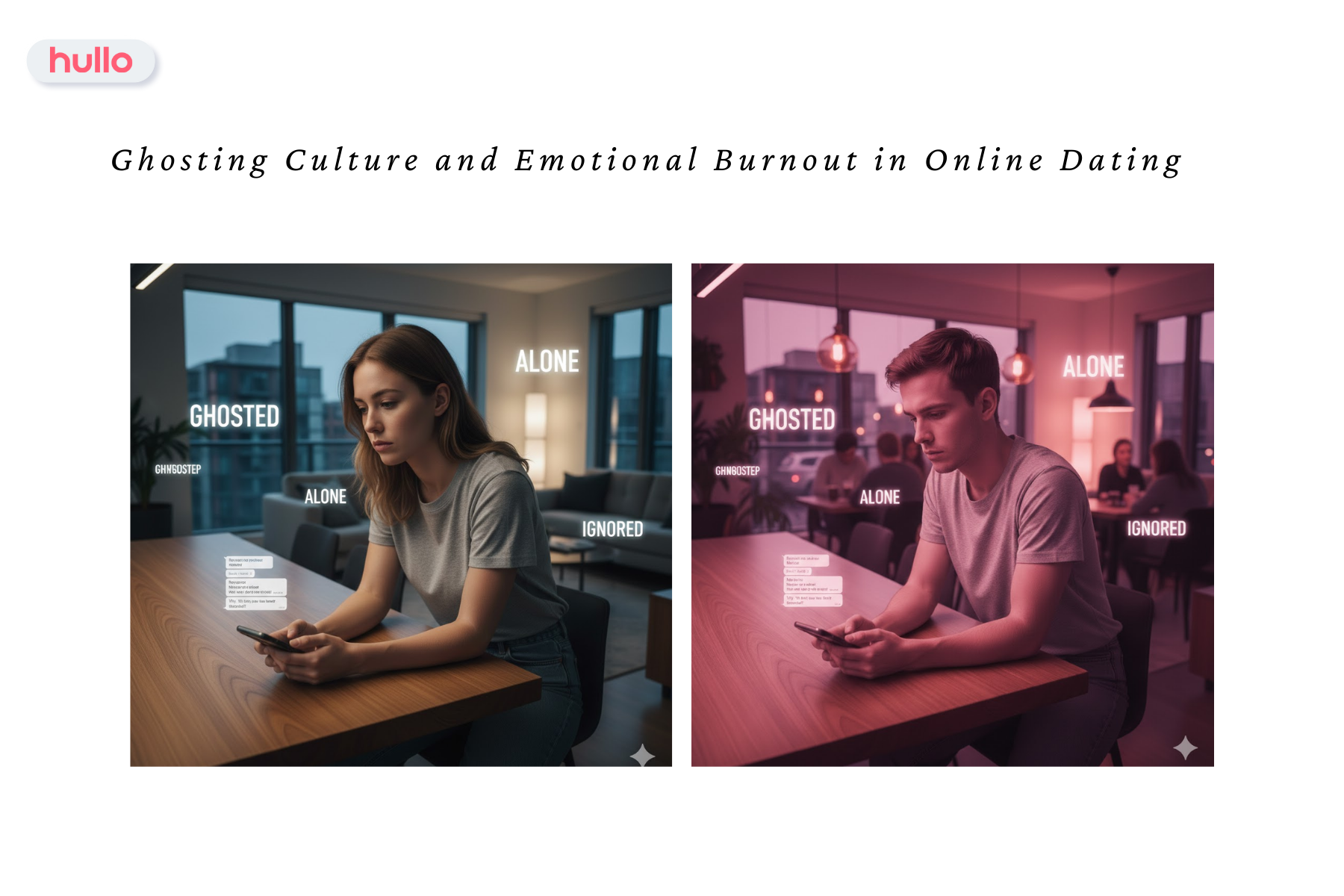
Ghosting dating apps does not just create short-term disappointment. Over time, it leads to emotional burnout. When conversations repeatedly end without explanation, people begin to lose motivation to invest in new connections. Each unanswered message adds to a quiet sense that effort may not be worth it anymore.
This is how dating fatigue starts. Users stop feeling excited about matches. Conversations become shorter, more cautious, and less personal. Instead of curiosity, there is hesitation. Instead of openness, there is emotional protection. Over time, this mirrors the patterns described in swiping culture and decision fatigue in modern dating, where repeated disappointments and endless choices gradually reduce emotional engagement.
Defensive dating is a natural response. People begin to limit how much they share, delay replies to avoid appearing too interested, or disengage early to avoid being ghosted first. While these behaviors can feel protective, they often reduce the quality of interactions and make meaningful conversations harder to sustain.
Over time, many users become emotionally cautious and less willing to invest in new connections. They may continue using dating apps, but with lower expectations and less enthusiasm. This gradual shift from curiosity to self-protection is one reason ghosting contributes so strongly to dating fatigue. When enough disappointing experiences accumulate, people stop approaching matches with excitement and start approaching them with caution.
As ghosting becomes normalized, emotional investment decreases, and meaningful connection becomes harder to sustain.
What Healthier Dating Apps Do Differently
Hullo helps reduce ghosting by matching users based on communication style and emotional compatibility: hullo.dating/ai-bio-generator
Healthier dating apps approach the problem differently. Instead of maximizing the number of matches, they focus on improving the quality of interaction. Better matching systems prioritize compatibility over volume, which reduces the likelihood of shallow conversations that fade quickly.
Emotional signals also play an important role. When users can express communication style, intent, and personality more clearly, conversations become more predictable and less ambiguous. This reduces misunderstandings that often lead to ghosting.
Another key difference is the shift toward fewer but deeper matches. When users are not overwhelmed by endless options, they are more likely to engage with intention. This creates a subtle sense of accountability, even in an online environment.
Rather than encouraging fast swiping, healthier platforms create space for slower, more meaningful interaction. That shift changes user behavior. When people feel that matches are relevant and worth exploring, they are less likely to disappear without explanation.
Voice and Authenticity Reduce Ghosting
Hullo’s First Voice feature helps users build real connection before matching: hullo.dating/download
One of the biggest reasons ghosting dating apps happens is the lack of human presence. Text and photos alone often feel abstract. Without tone, emotion, or nuance, it becomes easier to disengage.
Voice changes that dynamic. When users hear each other before matching, the interaction feels more real. A voice carries personality, emotion, and intention in a way text cannot replicate. This makes it harder to treat the other person as disposable.
Voice also reduces objectification. Instead of evaluating profiles based only on appearance or short bios, users respond to how someone expresses themselves. This adds depth early in the interaction.
Authenticity plays a similar role. When profiles reflect real personality rather than curated perfection, expectations become more aligned. Conversations start with a clearer understanding of who the other person is.
Together, voice and authenticity increase emotional presence. When interactions feel more human, people are more likely to communicate honestly and less likely to disappear without explanation.
How to Deal with Ghosting Dating Apps
Dealing with ghosting dating apps requires a shift in mindset as much as strategy. While you cannot control other people’s behavior, you can control how you respond to it.
First, do not personalize the rejection. Ghosting often reflects the other person’s avoidance or lack of readiness, not your value. Separating your self-worth from someone else’s silence helps reduce emotional impact.
Second, set expectations early. If communication becomes inconsistent, notice it instead of ignoring it. Patterns matter more than promises. This helps you adjust your level of investment in real time.
Third, avoid emotional over-investment in the early stages. It is easy to build a connection in conversation, but until there is consistency over time, keep your expectations balanced. This protects you from sudden disappointment.
Fourth, focus on consistency. People who show steady effort are more reliable than those who communicate intensely and then disappear. Pay attention to behavior, not just words.
For example, if reply times suddenly increase or engagement drops, it may be a signal to step back rather than push forward. Adjusting effort based on reciprocity helps maintain emotional balance.
Hullo helps users build more intentional and honest conversations from the start: hullo.dating
Ghosting dating apps is not just bad manners. It reflects emotional overload, swipe culture, and poor platform design.
Reducing ghosting requires dating spaces that value empathy and authenticity. By using AI to focus on compatibility and human signals, platforms like Hullo offer a healthier approach to modern dating.
People Also Ask
Why is ghosting so common on dating apps
Because endless options and low accountability make avoidance easier than honest communication.
Is ghosting emotionally harmful
Yes. Dating app ghosting is linked to anxiety, lower self worth, and dating fatigue.
Can dating apps reduce ghosting
Yes. Apps that focus on compatibility, voice interaction, and authentic profiles reduce ghosting behavior.