
 Dating in Singapore is a high-stakes exercise in logistics, social signaling, and long-term planning. To understand how to date in Singapore, one must first accept that the city-state operates on a unique “Pragmatic Heart” tension: a constant tug-of-war between the desire for organic romantic connection and the structural pressures of the “5Cs” (Car, Cash, Credit Card, Condominium, Country Club) and government-influenced social engineering. Unlike the spontaneous dating scenes of London or New York, Singaporean dating is often defined by its efficiency and the shadow of the Housing & Development Board (HDB) application.
According to the Singapore Department of Statistics (SingStat) 2023 Population in Brief report, the median age at first marriage has risen to 30.7 years for grooms and 29.1 years for brides. This delay is not merely a lifestyle choice but a reflection of a society where career stability and property acquisition are prerequisite steps to formalizing a relationship.
Dating in Singapore is characterized by a marriage-first trajectory driven by housing policies and high living costs. It differs from other global hubs through its “BTO-first, propose later” culture, where couples often apply for government housing years before a formal engagement. The scene is a blend of traditional family values and hyper-modern professional lifestyles, resulting in a dating pace that is cautious, pragmatic, and heavily reliant on digital vetting.
What Dating Culture Is Really Like in Singapore
Dating in Singapore moves with a calculated pacing. While the hookup culture exists within specific pockets of the nightlife scene in Clarke Quay or Tanjong Pagar, the general emotional pacing is conservative. Exclusivity is often assumed early; seeing multiple people after the third or fourth date is frequently viewed with skepticism by locals.
Gender roles remain a complex hybrid. While Singaporean women are among the most highly educated and career-driven in the world, traditional expectations regarding the provider role often persist. It is common for men to be expected to take the lead in planning and often paying for the initial dates, though going Dutch is becoming the standard for subsequent outings among Gen Z and younger Millennials.
A defining local nuance is the influence of the Asian Parent and the social circle. In Singapore, you are rarely just dating an individual; you are auditioning for a place within a tightly-knit ecosystem of family and lifelong school friends.
Professor Jean Yeung, a sociologist at the National University of Singapore (NUS), noted in a study on Singaporean family dynamics that the “extended transition to adulthood,” caused by high housing costs and educational demands, means that parents often retain a significant veto power or at least a heavy influence over their children’s romantic choices well into their late 20s.
The best way to date in Singapore is to combine high-intent apps with niche hobby-based social groups. Focus on transparency regarding career and life goals early on. Using a tool like Hullo can help refine your digital presence to attract partners who share your specific pragmatic and lifestyle values in this fast-paced city.
Demographics That Shape Dating in Singapore
The dating pool in Singapore is a reflection of its status as a global financial hub and a multi-racial state. The numbers tell a story of a shrinking local pool and a massive, transient foreign population.
-
Total Population: As of mid-2023, Singapore’s total population stood at 5.92 million residents, with roughly 1.77 million being non-residents.
-
The Gender Ratio: Among the resident population, the gender ratio is roughly 964 males per 1,000 females, creating a slightly more competitive environment for women seeking local male partners in certain age brackets.
-
Household Statistics: The increasing number of one-person households, which reached 15.7% in 2023, suggests a growing segment of the population navigating the complexities of modern singleness.
These statistics create a scarcity mindset in the dating market. The high percentage of foreign residents (roughly 30%) means that the dating scene is split into two parallel tracks: the local track (focused on HDBs, family, and long-term stability) and the expat track (focused on social clubs, travel, and high-disposable-income experiences).
Finding the right words to describe your career and ambitions is crucial in Singapore. If you are struggling to articulate your profile, the Hullo AI Bio Generator can help you create a balanced, attractive introduction.
Who You’ll Meet When Dating in Singapore
The Local Professionals (The Heartlanders)
Often living with parents until marriage due to the HDB rules, these individuals are pragmatic, hardworking, and deeply rooted in local food culture. They value stability and are often looking for a partner to “BTO” (Build-To-Order) with.
The Western Expats
Concentrated in sectors like Finance, Tech, and Law. They often frequent bars in Telok Ayer and Duxton Hill. Their dating style is typically more casual and Westernized, which can sometimes clash with local expectations of early exclusivity.
The Returnees
Singaporeans who studied in the UK, US, or Australia. They bridge the gap between local values and international mindsets, often seeking partners who understand both the kiasu (fear of losing out) culture and global perspectives.
The Regional Nomads
Professionals from neighboring Malaysia, Indonesia, and the Philippines. They often share similar cultural values with locals but face the added pressure of work-visa stability, which can influence their dating urgency.
Online Dating in Singapore: Behavioral Reality
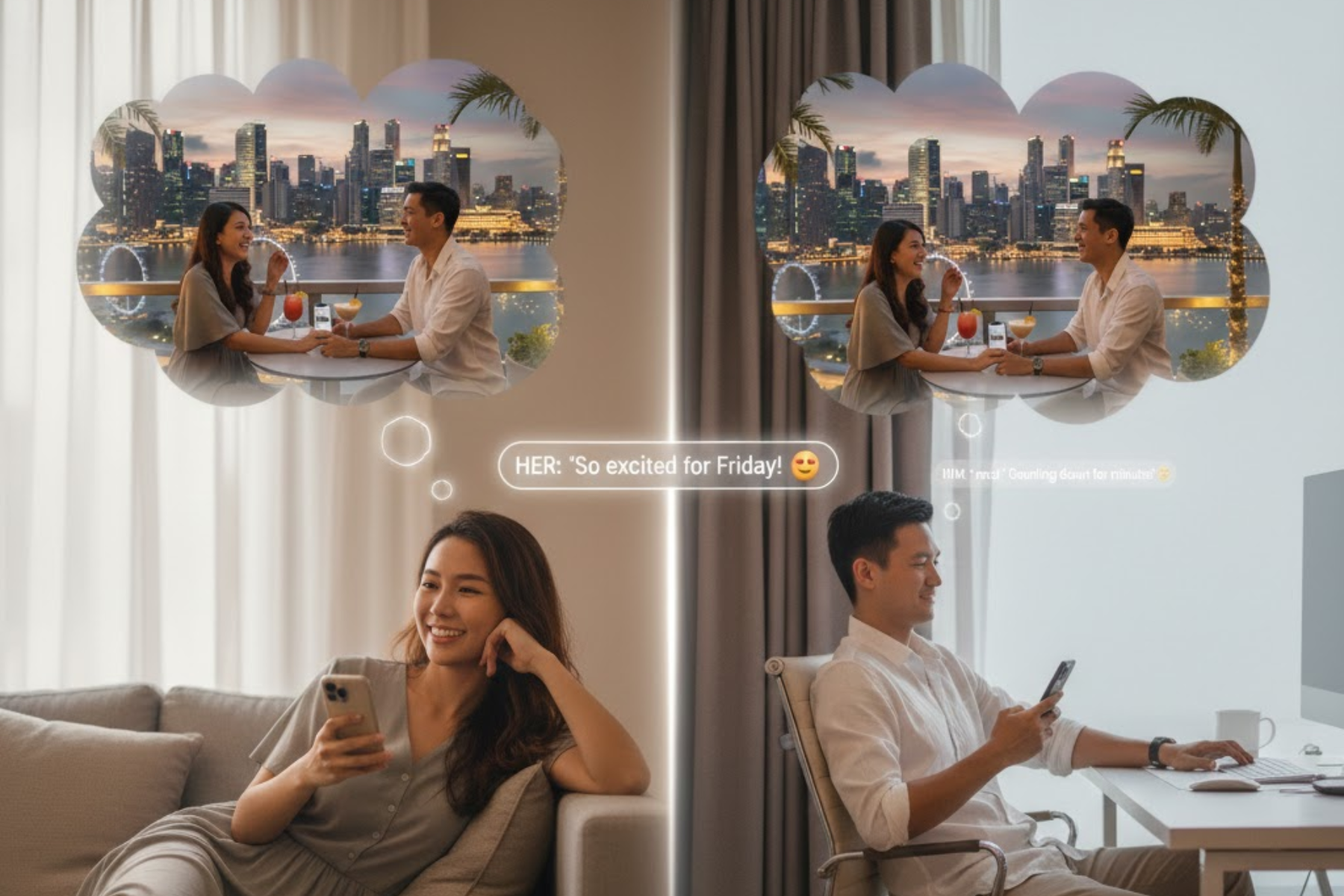
Online dating is the primary meat market in Singapore. Because the city is so small, six degrees of separation is more like two. It is very common to see a friend of a friend on an app.
-
Messaging Expectations: Singaporeans are generally responsive but concise. Long, poetic paragraphs are often met with confusion. Efficiency is key.
-
The Kiasu Filter: Profiles often list heights, job titles, and educational backgrounds with interview-like precision.
-
Ghosting Patterns: Ghosting is prevalent, often used as a polite way to avoid the perceived confrontation of a formal rejection.
The term dating in Singapore often implies a high level of digital vetting before a first meeting. People will likely check your LinkedIn before they check your Instagram. Research from local social analysts suggests that Singaporeans prioritize “lifestyle compatibility” over purely physical attraction, leading to highly detailed profile prompts.
Dating Tip: Navigating the nuances of local etiquette can be tricky. For a smoother experience, download Hullo to connect with people who are looking for the same relationship depth as you.
Offline Dating in Singapore: What Actually Works
Cold approaching strangers in Singapore is rare and often viewed as intrusive. Social life revolves around structured environments.
The Third Place Culture
Since many locals live with parents, dating happens almost entirely in public. This has created a massive culture of cafe hopping in neighborhoods like Tiong Bahru or Everton Park. These spaces serve as neutral ground for the initial vibe check.
Interest-Based Groups
Joining a Run Club (like those meeting at Marina Bay) or a specialized gym (F45 or Bouldering gyms) is currently the most effective way to meet people offline. These environments provide the social proof that Singaporeans value.
The Alcohol Factor
Singapore has some of the highest alcohol taxes in the world. Consequently, grabbing a drink is a significant financial commitment compared to other cities. A date at a speakeasy in Amoy Street signals a different level of intent and status than a coffee date.
Common Dating Mistakes in Singapore
-
The BTO Too Early: Discussing government housing on a first or second date is a meme, but doing it seriously can be a major red flag or green flag depending on the person. It is often too much pressure, too soon.
-
Disrespecting the Hawker Culture: Assuming a date must be expensive to be valid. Some of the best chemistry tests happen over a $5 plate of Hainanese Chicken Rice.
-
Ignoring the Family Dynamic: Underestimating how much a Singaporean values their parents’ opinion. If you are serious, you are dating the family.
-
Complaining about Singapore: If you are an expat, constant complaining about the humidity or the laws is the fastest way to kill a spark. Locals are fiercely proud of their city’s efficiency.
Do and Don’t When Dating in Singapore
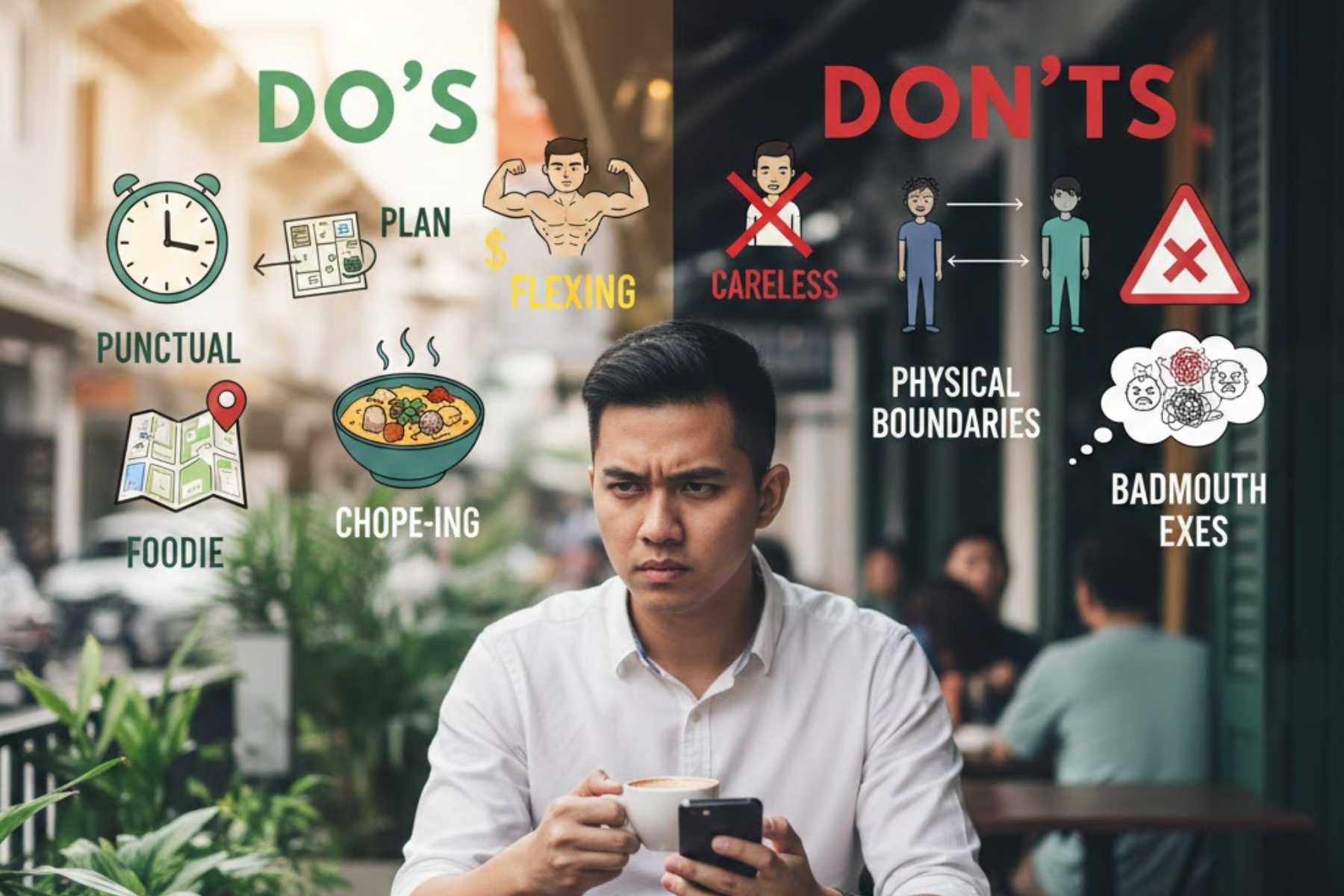
DO:
-
Be Punctual: In a city where trains run on a 2-minute frequency, being 15 minutes late is considered disrespectful.
-
Have a Plan: Efficiency is attractive. “I don’t know, what do you want to do?” is a dating death sentence.
-
Respect Chope-ing: Understand the local quirks, like saving seats with tissue packets. It shows you belong.
-
Embrace the Foodie Identity: Be willing to travel to the ulu (remote) parts of the island for a famous laksa.
DON’T:
-
Flex Too Hard: While status matters, overt bragging about wealth can come off as low-class or insecure.
-
Assume Casual Means Careless: Even a casual date requires a level of grooming and presentation.
-
Overstep Physical Boundaries: Singapore is still relatively conservative; wait for clear signals before initiating physical contact.
-
Badmouth Exes: The community is small. You never know who knows whom.
30-Day Dating Strategy for Singapore
Week 1–2: The Digital Sieve
Focus on optimizing your apps. Use high-quality photos that show you in different settings (one professional, one social, one active). Start conversations that move toward a “vibe check” within 3 to 5 days of matching.
Week 3: The Activity Date
Instead of a standard dinner, suggest an activity that allows for conversation but reduces pressure. A walk at Gardens by the Bay or a visit to an ArtScience Museum exhibition works well. It allows you to gauge their curiosity and cultural fit.
Week 4: The Integration
If the first two dates went well, choose a location that is meaningful to you—a favorite local haunt or a hidden bar. This is the time to see if your social battery and communication styles align for the long term.
Whether you are looking for a casual coffee or a long-term partner to navigate the city with, Hullo provides the platform to meet quality singles in Singapore.
People Also Ask
Is dating in Singapore expensive? Yes, Singapore is consistently ranked as one of the most expensive cities in the world. According to the Economist Intelligence Unit (EIU), it frequently tops the Worldwide Cost of Living index. A standard dinner-and-drinks date at a mid-range restaurant in the CBD can easily cost $150 to $200 SGD.
What does BTO mean in the dating context? BTO stands for Build-To-Order, a system for purchasing new government-subsidized flats. Because the wait time for these flats can be 3 to 5 years, many Singaporean couples apply for a flat before they are even engaged. In dating slang, asking someone to BTO is essentially a pragmatic marriage proposal.
How do locals view dating expats? The Expat-Local dating dynamic is common but carries certain stereotypes. While many successful long-term relationships exist, there is sometimes a perception that expats are transient and not looking for long-term stability. Clear communication about one’s duration of stay in Singapore is vital for managing expectations.
Is there a specific dating age in Singapore? The pressure to date intensifies in the late 20s. This is largely due to the 35-year-old rule, where single Singaporeans can only purchase HDB flats on their own once they reach age 35. This creates a demographic rush to find a partner before 30 to secure housing earlier.
What is the best app for serious dating in Singapore? While Tinder is used for casual encounters, Coffee Meets Bagel and Bumble are the dominant players for those seeking long-term relationships. These apps cater better to the vetted and professional requirements of the Singaporean dating market.
Does religion play a role in Singaporean dating? Yes, religion is a significant factor. According to the 2020 Census, Singapore is religiously diverse (Buddhism 31.1%, Christianity 18.9%, Islam 15.6%). Many individuals prioritize partners within the same faith to ensure family harmony and easier marriage proceedings.